Unpacking the Art and Science of Radio Frequency Identification
RFID is one of those technologies most of us interact with far more often than we realise.
It helps businesses identify stock moving through warehouses, controls access to buildings, tracks equipment and assets, and can even identify exactly which device an employee has borrowed.
But behind what can appear to be a simple tag is more than 80 years of development in radio communication, engineering and identification technology.
Some RFID tags can communicate without having a battery of their own. Different frequencies behave differently around certain materials. The position of a tag can affect its performance. Metal can interfere with an RFID signal. And choosing the right tag can be just as important as choosing the reader.
Understanding RFID therefore means going a little deeper than simply knowing what those four letters stand for.
In this guide, we’re unpacking RFID: what it is, where it came from, how it works, the different types, its benefits and the engineering considerations involved in making it work reliably in the real world.
We’ll also explain how we use RFID at iLockerz to help organisations automatically identify and manage their assets.
What is RFID?
RFID stands for Radio Frequency Identification.
At its simplest, RFID is a technology that uses radio waves to identify physical objects.
An RFID system usually consists of three key components:
- An RFID tag attached to an object
- An RFID reader that communicates with the tag
- Software that interprets the information and connects it to a digital record
Each tag can contain a unique identifier. This means a system can distinguish one tagged asset from another.
Imagine a business owns 100 identical handheld scanners.
Knowing that a scanner has been returned isn’t necessarily enough. The business may need to know exactly which scanner has been returned, who previously had it and whether another device is still missing.
Give every scanner its own tag and each physical device can be associated with its own digital identity.
This is where RFID becomes particularly useful for asset management.
And unlike a traditional barcode, RFID does not necessarily require direct line-of-sight between the tag and reader.
The reader communicates using radio waves, allowing identification to become increasingly automated.
But the idea of identifying objects using radio signals isn’t new.
Its origins take us back more than 80 years.
Where Did RFID Come From?
RFID doesn’t have one simple moment of invention.
Instead, the technology evolved from decades of developments in radio communication, radar, electronics and computing.
Its story can be traced back to the development of radar and identification technology around the Second World War.
From detection to identification
Radar created an extraordinary new capability: objects such as aircraft could be detected using radio waves from beyond normal visual range.
But detecting an aircraft created another problem.
Whose aircraft was it?
Being able to detect something wasn’t necessarily enough. Military operators also needed a way of distinguishing friendly aircraft from potentially hostile ones.
This contributed to the development of Identification Friend or Foe (IFF) systems.
Friendly aircraft equipped with a transponder could respond to an interrogation signal, helping the system establish their identity.
It wasn’t RFID as we know it today, but the underlying concept should sound familiar:
A radio signal is sent towards an object. The object responds. That response helps establish its identity.
1948: reflected radio energy
Another important milestone arrived in 1948 when American scientist Harry Stockman published Communication by Means of Reflected Power.
His research explored how information could be communicated using reflected radio energy.
The concept would become particularly significant in the development of passive RFID technology.
The theory existed, but making it practical required advances in electronics.
As transistors, integrated circuits and computing developed over the following decades, researchers were able to make radio identification systems smaller and increasingly practical.
RFID begins to take shape
By the 1970s, RFID technology was becoming much more recognisable.
Inventors including Mario Cardullo and Charles Walton developed and patented important radio-frequency identification technologies, while researchers at Los Alamos National Laboratory explored RFID systems for identifying vehicles transporting nuclear materials.
RFID gradually moved from experimental and specialist applications towards commercial ones.
Over the following decades, improvements in microchips, readers, antennas and software made RFID increasingly practical and affordable.
Today, the applications may look very different from those early systems, but the fundamental objective remains remarkably similar:
Identify a physical object using radio-frequency technology and connect that identity to useful information.
How Does RFID Work?
At the centre of an RFID system is a conversation between a reader and a tag.
The RFID reader generates a radio-frequency signal through its antenna.
When a compatible RFID tag enters the reading area, the tag can communicate information back to the reader.
That information can then be passed into software, where the tag’s unique identity can be associated with a particular physical asset.
So, for example, an RFID tag could be attached to a handheld scanner.
The software might know:
RFID Tag 123456 = Scanner 24
When that tag is detected, the system doesn’t simply know that something is present.
It knows that Scanner 24 is present.
And when RFID is combined with another piece of information — such as an authenticated user — things become much more interesting.
A system can begin to create records such as:
Employee A → collected → Scanner 24 → at 08:02
And later:
Employee A → returned → Scanner 24 → at 16:47
Suddenly, RFID isn’t simply identifying an object.
It’s helping create an automated audit trail around that object’s use.
How can an RFID tag work without a battery?
This is one of the cleverest aspects of RFID.
Not every RFID tag requires its own battery.
A passive RFID tag can use energy from the electromagnetic field generated by the reader to power the tiny electronic circuitry within the tag.
The tag can then communicate information back to the reader.
This process happens incredibly quickly and allows very small, inexpensive tags to identify physical objects without requiring their own conventional power source.
And that’s one of the reasons RFID has become useful across so many different applications.
What Are the Different Types of RFID?
RFID isn’t one single technology.
Different RFID systems operate at different frequencies and have different characteristics, reading ranges and applications.
The three broad frequency groups you will commonly encounter are:
Low Frequency (LF)
Low Frequency RFID generally operates around 125–134 kHz.
LF typically provides relatively short reading distances but can perform well in certain challenging environments.
Applications can include animal identification, access control and specialist industrial uses.
High Frequency (HF)
High Frequency RFID typically operates at 13.56 MHz.
One of the most familiar forms of HF technology is NFC — Near Field Communication.
NFC is commonly used in applications such as contactless cards, smartphones, access systems and other short-range interactions.
Ultra-High Frequency (UHF)
UHF RFID generally operates across higher frequency bands and can provide significantly greater read ranges than LF or HF systems, depending on the equipment and environment.
UHF is widely used for applications such as:
- Asset tracking
- Inventory management
- Warehousing
- Logistics
- Supply chain management
- Equipment identification
The correct frequency depends entirely on the application.
More range isn’t automatically better.
Reliable RFID is about selecting the technology that suits the asset, environment and process.
Active vs Passive RFID
RFID tags can also be broadly divided into active and passive technologies.
Passive RFID
Passive RFID tags do not contain their own battery.
Instead, they use energy provided by the RFID reader’s electromagnetic field to communicate.
This means passive tags can be:
- Small
- Cost-effective
- Low maintenance
- Suitable for tagging large numbers of assets
Active RFID
Active RFID tags contain their own power source, usually a battery.
Having their own power source can allow active tags to communicate across greater distances and support applications where assets need to be detected over a wider area.
The trade-off is that active tags are generally larger, more expensive and require battery management.
Neither is inherently better.
The correct choice depends on what you’re trying to identify, where you’re trying to identify it and what information you need from the system.
The Art of RFID: Making It Work in the Real World
On paper, RFID can sound remarkably simple.
Attach a tag.
Install a reader.
Read the tag.
In reality, achieving reliable RFID performance can require considerably more thought.
Radio waves interact with the physical world around them.
That means RFID performance can be influenced by factors including:
- The material an asset is made from
- Nearby metal
- Liquids
- The orientation of the tag
- The position of the reader
- The distance between tag and reader
- The RFID frequency being used
- The design of the antenna
- Other tagged objects within the reading area
This is where RFID becomes as much about application and engineering as the technology itself.
A tag that performs perfectly in one environment might behave very differently when attached to another object.
Why can metal cause problems for RFID?
Metal is a particularly important consideration.
Metal surfaces can interfere with the electromagnetic fields used by RFID systems and affect the performance of certain tags.
This matters because many of the assets organisations want to track contain metal.
Tools.
Radios.
Scanners.
IT equipment.
Engineering equipment.
Simply attaching a standard RFID tag directly to a metal surface may therefore produce very different results from attaching that same tag to cardboard or plastic.
Specialist on-metal tags are available, but the type of tag, its positioning and the environment surrounding it still matter.
This is an important lesson in RFID:
The tag is only one part of the system.
How and where you use it matters too.
What Are the Benefits of RFID?
When RFID is implemented effectively, it can provide significant benefits for organisations managing physical assets.
Faster identification
RFID can reduce the need for employees to manually locate and scan individual barcodes.
Assets can instead be identified as they enter an appropriate RFID reading area.
Greater asset visibility
Giving individual assets their own RFID identity allows organisations to build a more accurate digital record of their equipment.
This can make it easier to establish which assets are available, issued or potentially missing.
Improved accountability
Combine RFID identification with user authentication and software, and organisations can create a detailed audit trail.
Instead of knowing only that an asset has disappeared, the business can potentially establish which asset was taken, who accessed it and when the transaction occurred.
Reduced manual administration
Many asset-management processes still rely on spreadsheets, paper records or employees manually recording equipment movements.
RFID can automate parts of this process, reducing administration and the potential for human error.
Improved utilisation
Greater visibility can also help organisations understand how their assets are actually being used.
Which equipment is constantly in demand?
Which assets rarely leave storage?
Which devices are regularly overdue?
This information can help organisations make better decisions about purchasing and asset allocation.
Self-service
RFID becomes particularly powerful when combined with secure self-service technology.
Employees can potentially borrow and return equipment without requiring another member of staff to manually manage every transaction.
What Industries Use RFID Today?
RFID technology is now used across an enormous range of industries.
Warehousing and Logistics
Warehouses and logistics businesses can use RFID to identify stock, equipment and shared operational devices.
For organisations working across multiple shifts, RFID can also help manage equipment such as handheld scanners by establishing exactly which device has been issued to which employee.
Manufacturing and Engineering
Manufacturers can use RFID for inventory, production processes, tool management and equipment tracking.
When valuable tools are shared across employees or departments, assigning each item a unique identity can significantly improve accountability.
Emergency Services
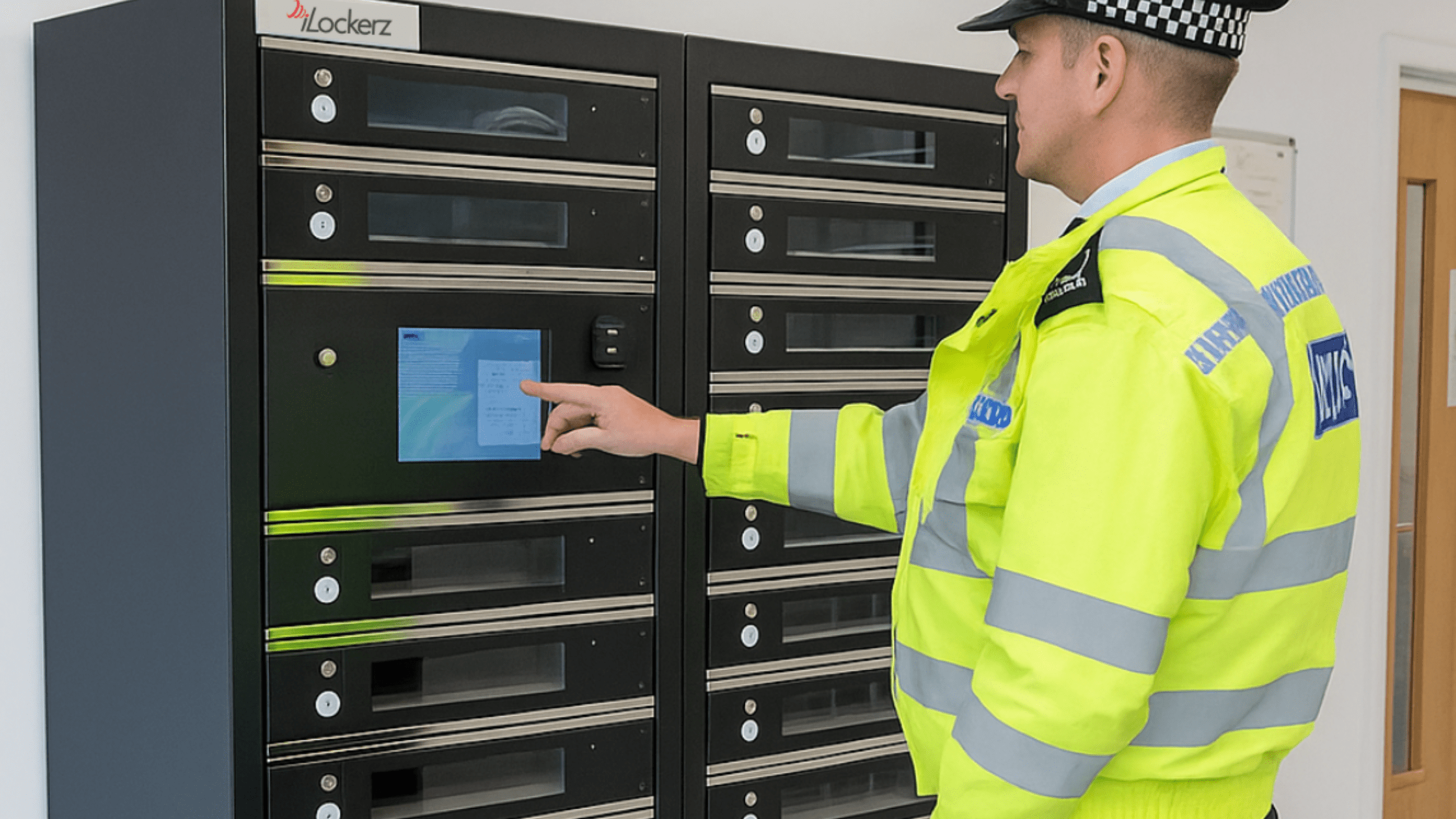
Police and other emergency services manage large quantities of mission-critical equipment, including radios, IT devices and specialist operational equipment.
RFID can form part of a system that provides greater visibility over which assets have been issued and whether they have been returned.
IT and Technology
Organisations can use RFID to manage shared laptops, tablets, peripherals and other IT equipment.
It can be particularly useful where employees need self-service access to devices, replacement equipment or shared assets.
Retail
Retail is one of RFID’s most visible modern applications.
RFID can be used for stock identification, inventory accuracy, supply-chain visibility and increasingly automated stock-management processes.
Transport and Infrastructure
Transport and infrastructure organisations often have large, distributed workforces relying on shared equipment.
RFID can help provide greater accountability and visibility over these operational assets.
How Does iLockerz Use RFID?
At iLockerz, we use RFID as part of a wider smart asset management system.
Because secure storage alone doesn’t necessarily solve the asset-management problem.
Imagine 20 identical scanners are stored inside a locker.
An employee authenticates themselves and opens a compartment.
Knowing that the door opened is useful.
But what if you also need to know exactly which scanner they took?
That’s where RFID comes in.
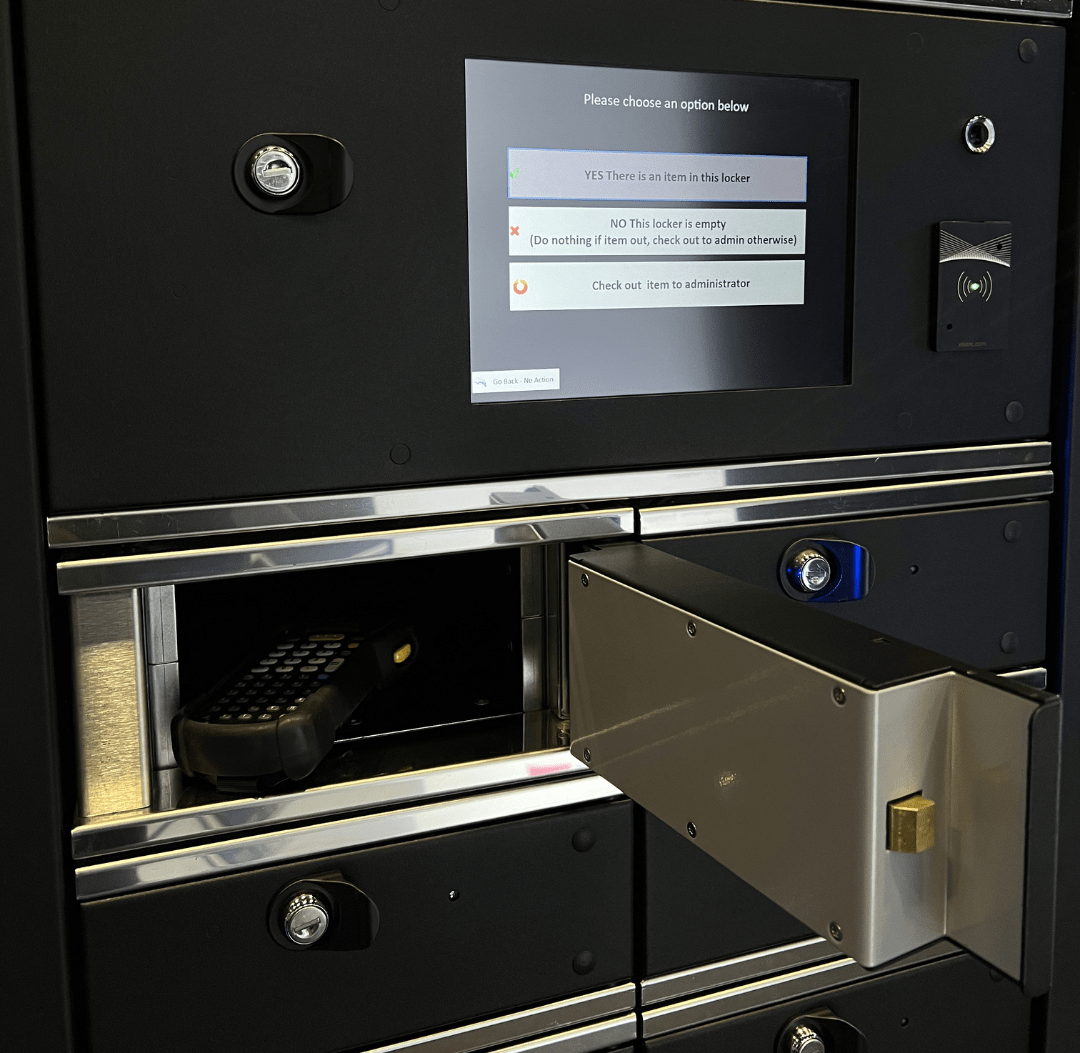
By associating an individual RFID tag with an individual asset, the iLockerz system can identify the equipment involved in a transaction.
Combine this with user authentication and our smart locker software and organisations can create a digital record showing:
- Who accessed the system
- What asset they borrowed or returned
- When the transaction happened
- Whether the asset has been returned
- Which assets remain available
Rather than relying on employees to manually record asset movements, RFID can make identification part of the process itself.
Why we created an RFID Tag Cap
Working with RFID in real-world environments also means solving some very practical engineering challenges.
One of those challenges is achieving reliable tag performance around the assets we’re managing.
As we’ve already explored, factors such as metal and tag positioning can influence RFID performance.
This led us to develop our RFID Tag Cap.
The Tag Cap gives us a consistent way of positioning an RFID tag on compatible assets and helps us achieve reliable performance within our smart locker applications.
It’s a relatively small part of the overall system, but it demonstrates something much bigger about RFID.
Reliable RFID isn’t achieved by simply sticking a tag onto an asset.
The environment, the asset, the reader, the tag and its positioning all have to work together.
Watch: Why We Created the iLockerz RFID Tag Cap
Why Does iLockerz Use RFID?
Because we want to remove as much manual intervention from asset management as possible.
Traditional equipment-management processes can depend on keys, sign-out sheets, spreadsheets, staffed equipment rooms or employees manually scanning every asset.
A smart locker already gives organisations a way to control who can access equipment.
RFID allows us to go one step further and identify which individual asset they actually take or return.
That’s an important distinction.
If ten identical scanners are available, it’s not enough for some organisations to know that an employee took a scanner.
They need to know they took Scanner 07.
By bringing together RFID, secure storage, user authentication and intelligent software, iLockerz can help organisations create a self-service asset-management process with a comprehensive digital audit trail.
Employees get access to the equipment they need.
Managers get visibility over their assets.
And the system handles much of the administration automatically.
For us, that’s the real value of RFID.
It’s not the tag itself.
It’s what knowing the identity of an asset allows you to do.
RFID Frequently Asked Questions
What does RFID stand for?
RFID stands for Radio Frequency Identification. It is a technology that uses radio-frequency signals to identify tagged objects.
Who invented RFID?
RFID cannot easily be attributed to a single inventor. Its development grew from earlier radio and radar technologies, with important contributions including Harry Stockman’s research into reflected radio communication in 1948 and later work by inventors such as Mario Cardullo and Charles Walton during the 1970s.
When was RFID invented?
There isn’t one universally accepted invention date. RFID’s technological roots can be traced to radio and identification systems developed around the Second World War, with important theoretical work appearing in the 1940s and recognisable RFID technologies developing during subsequent decades.
Does RFID need line-of-sight?
Not necessarily. Unlike barcodes, RFID tags don’t generally need to be visually aligned with a reader. The exact performance depends on the RFID technology, tag, reader and surrounding environment.
Does an RFID tag need a battery?
Not always.
Passive RFID tags operate without their own battery, while active RFID tags contain their own power source.
How far away can RFID be read?
There isn’t one standard RFID read distance.
Range depends on factors including the RFID frequency, whether the tag is active or passive, the reader, antenna, tag design, surrounding environment and material the tag is attached to.
Can RFID track someone’s location?
RFID identifies tagged objects when they interact with an appropriate RFID system. Some RFID technologies can form part of real-time location systems, while other applications simply record that an asset was detected at a particular reader or location.
For example, detecting that an asset has been removed from or returned to a smart locker is different from continuously tracking its location.
Can RFID work on metal?
Yes, but metal can affect RFID performance.
Specialist on-metal tags and appropriate tag positioning can be used for applications involving metal assets. The correct approach depends on the tag, frequency, asset and environment.
What is the difference between RFID and a barcode?
Both technologies can identify assets.
A barcode generally needs to be visible and manually aligned with a scanner. RFID communicates using radio waves and doesn’t necessarily require direct line-of-sight.
This can allow RFID identification to become more automated.
Is RFID better than a barcode?
Not necessarily.
Barcodes are inexpensive, simple and extremely effective for many applications.
RFID can be more appropriate where automated identification, reduced manual scanning or greater asset visibility is required.
The right technology depends on the application.
What can RFID be used to track?
RFID can be used to identify an enormous range of physical items.
In asset-management environments this could include:
- Handheld scanners
- Radios
- Tools
- Laptops
- Tablets
- IT equipment
- Keys
- Operational equipment
- Inventory and stock
From Identification to Intelligent Asset Management
RFID has come a long way from its early roots in radio and identification technology.
But throughout that evolution, one idea has remained remarkably consistent:
How can we reliably identify a physical object using radio technology?
Today, answering that question opens up possibilities far beyond identification alone.
Connect an RFID identity to a user, a secure smart locker and intelligent asset-management software and businesses can begin to automate the entire process of issuing and returning shared equipment.
They can know what equipment is available.
What has been borrowed.
Who has it.
And whether it has been returned.
That’s where RFID becomes much more than a tag.
It becomes part of a smarter way to manage physical assets.
Want to explore RFID asset management for your organisation?
Discover how iLockerz combines smart lockers, RFID technology and intelligent software to give organisations greater control and visibility over their assets.